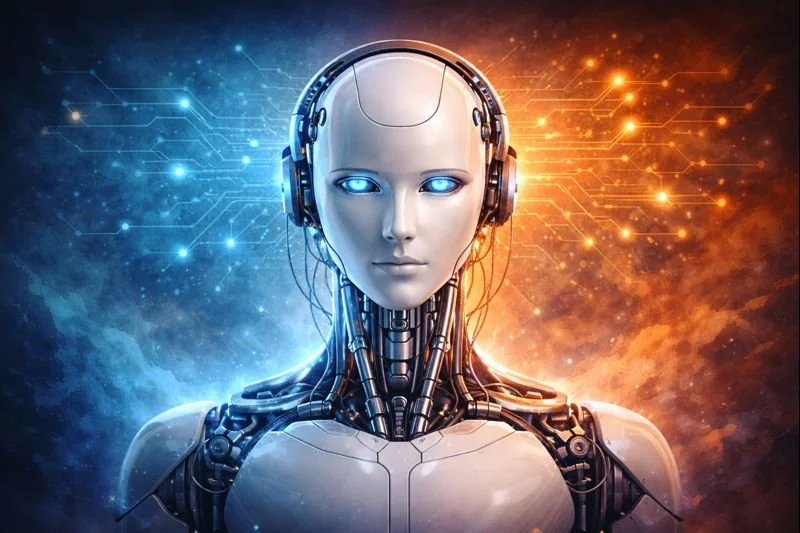
From Neurons to Networks: How Biology and Computers Together Shaped Cognitive Psychology
As technology advances, the boundary between the human mind and machine intelligence continues to blur. What began as a simple metaphor during the cognitive revolution has evolved into a deeper understanding of how biological neurons inspire modern computing systems. By exploring the anatomy of the brain alongside emerging neural-based technologies, we gain new insight into how cognition is both a biological and computational process.It All Begins Here
The cognitive revolution of the mid-20th century transformed psychology by shifting the focus from observable behavior to internal mental processes such as attention, memory, and problem solving. A major influence on this shift came from advances in computer technology and early ideas about artificial intelligence. In 1950, Alan Turing proposed that machines could demonstrate intelligent behavior, sparking comparisons between how computers process information and how the human mind operates. This metaphor of the mind as an information-processing system became foundational to cognitive psychology and continues to shape how scientists understand thinking today.
However, the computer metaphor alone does not fully explain cognition without considering the brain’s biological structure, especially the neuron. Neurons are specialized cells that transmit information throughout the nervous system. Each neuron has dendrites that receive signals, a cell body that processes those signals, and an axon that sends electrical impulses to other neurons. These impulses, known as action potentials, allow information to move rapidly across vast neural networks. Much like computers rely on circuits to transmit data, the brain relies on interconnected neurons to process, store, and retrieve information. Cognitive psychologists use this biological foundation to explain how sensory input becomes perception, how experiences become memories, and how thoughts lead to decisions.
The connection between neurons and computing becomes clearer when considering how both systems encode and transmit information. Computers translate data into binary code, zeros and ones, so it can be manipulated by hardware and software. Similarly, neurons convert sensory energy such as light and sound into electrical signals the brain can interpret. These neural codes allow the brain to recognize patterns, store knowledge, and respond to the environment. This biological processing supports many cognitive functions studied in psychology, including attention, learning, and reasoning. Without understanding neurons, the information-processing model of the mind would be incomplete.
Modern advances in biological and brain-inspired computing further strengthen this connection between cognition and neuroscience. One major development is neuromorphic computing, which designs computer systems modeled after neural networks in the human brain. These systems aim to mimic how neurons communicate through spikes of electrical activity rather than through traditional linear code. Researchers have found that this approach allows machines to process information more efficiently, learn from experience, and adapt to new situations, abilities that resemble human cognition. These innovations highlight how studying the brain’s structure directly informs the future of intelligent technology.
An academic framework that bridges biology and cognition comes from information-processing theories of the brain, which propose that mental activity emerges from neural communication patterns. Research in cognitive neuroscience demonstrates that specific neural circuits support attention, memory storage, and problem solving. For example, changes in synaptic strength between neurons explain learning through a process known as neural plasticity. This supports the idea that cognition is not only computational but also deeply biological. The mind’s software of thoughts and memories depends entirely on the brain’s hardware of neurons and synapses.
In conclusion, the cognitive revolution expanded psychology by introducing the computer metaphor of the mind, but true understanding of cognition requires integrating biological foundations. Neurons function as the brain’s information-processing units, transmitting and transforming data much like circuits in a computer. Advances in neuromorphic and biological computing now reflect this natural design, showing how closely intelligence is tied to neural structure. By combining cognitive psychology with neuroscience, researchers gain a richer understanding of how thought emerges from both computation and biology, revealing that the human mind is not just like a computer, but a living, adaptive network far more complex than any machine.